Lion, A Complete Guide to the World’s Most Social Big Cat
A lion’s roar carries across the darkness before the animal itself becomes visible. Somewhere beyond the trees, a pride is announcing its presence. Nearby, antelope remain alert, hyenas listen and other lions may answer. The sound belongs to an animal whose influence extends well beyond the moment of a hunt.
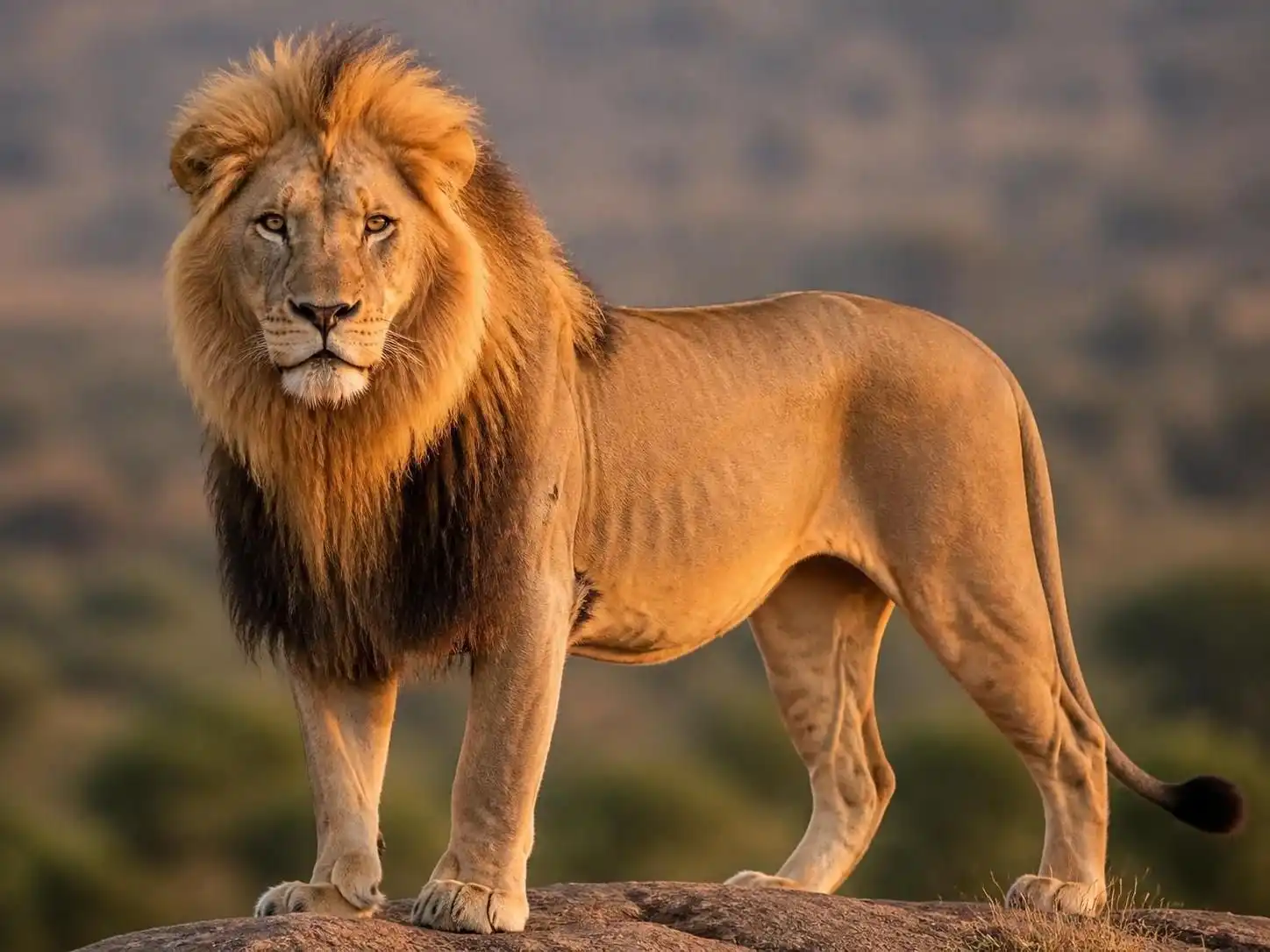
The lion is among the most recognizable mammals on Earth. Its muscular build, tawny coat and the adult male’s mane have made it a symbol of strength in cultures across the world. Yet familiar images can hide a more complicated reality.
Lions are neither solitary kings ruling over obedient families nor predators that succeed every time they hunt. Their lives involve cooperation, competition, failed attempts, territorial risk and the difficult task of raising vulnerable cubs. Females form the lasting social core of many prides, while males often cooperate in coalitions.
Their conservation story is equally complex. Some populations are recovering under effective protection, while others are declining or becoming increasingly isolated. India’s Asiatic lions have increased in number, but that progress does not remove the risks associated with a geographically concentrated population.
Counting lions also requires care. An estimate of African adults and subadults cannot simply be added to an Indian count that includes cubs and presented as a precise worldwide total.
This guide explores the lion’s identification, classification, habitat, diet, adaptations, social behavior, reproduction and ecological importance. It also explains current conservation evidence, dated population estimates and several common misconceptions about this remarkable cat.
Lion Facts
| Feature | Information |
|---|---|
| Common name | Lion |
| Scientific name | Panthera leo |
| Family | Felidae |
| Genus | Panthera |
| Commonly recognized subspecies | P. l. leo and P. l. melanochaita |
| Native modern distribution | Parts of Africa and Gujarat, India |
| Typical habitats | Savanna, grassland, woodland, scrub and suitable dry forest |
| Diet | Primarily medium-sized and large vertebrate prey, especially hoofed mammals |
| Feeding category | Carnivore |
| Adult male weight | Commonly around 150–225 kilograms, varying by population |
| Adult female weight | Often around 120–180 kilograms, with substantial variation |
| Social unit | Pride |
| Male association | Often a coalition |
| Gestation | Approximately 110 days |
| Typical litter | One to four cubs |
| Activity | Often most active during cooler hours and at night |
| Longevity | Some survive into their teens in the wild; longer survival occurs in human care |
| Global conservation status | Vulnerable |
| Important population distinction | Regional estimates use different dates, methods and age categories |
1. What Is a Lion?
The lion is a large carnivorous mammal belonging to Felidae, the cat family. It is a member of Panthera, the genus that also includes tigers, leopards, jaguars and snow leopards.
Among cats, lions are especially notable for their regular, complex group living. Their social organization influences almost every part of their biology, including hunting, territorial defense, mating and the survival of cubs.
A lion is also a predator adapted to bursts of force rather than prolonged pursuit. Its powerful body is useful when closing the final distance, grappling with prey and holding an animal substantially larger than itself.
However, a lion’s life is not one uninterrupted sequence of attacks. Rest, social contact, feeding, territorial assessment and movement occupy much of its time.
The familiar title “king of the jungle” is cultural rather than ecological. Most lions do not live in dense tropical rainforest, and their influence does not resemble the authority of a human ruler.
Understanding lions becomes easier when these symbolic descriptions are set aside and the animal is considered within its own social and ecological setting.
2. Scientific Classification and Subspecies
Classification
| Taxonomic level | Classification |
|---|---|
| Kingdom | Animalia |
| Phylum | Chordata |
| Class | Mammalia |
| Order | Carnivora |
| Family | Felidae |
| Genus | Panthera |
| Species | Panthera leo |
The two-subspecies framework
A widely used modern classification recognizes two living subspecies:
- Northern lion, Panthera leo leo: includes lions in parts of western and central Africa and the Asiatic population.
- Southern lion, Panthera leo melanochaita: includes populations associated with eastern and southern Africa.
The Zoological Society of London uses this framework, which differs from the older division into one African and one Asiatic subspecies.
Why older names remain common
The name Panthera leo persica still appears in scientific literature, government material and public descriptions of Asiatic lions.
This does not mean every source using it is discussing a different animal. It reflects differences in taxonomic treatment and the persistence of familiar terminology.
“African lion” remains useful geographically, but it should not automatically be interpreted as one subspecies under the two-subspecies framework.
Classification helps describe ancestry and relationships; it does not replace attention to the needs of individual populations.
3. Appearance and Identification
Body shape
Lions have deep chests, muscular limbs, broad heads and powerful jaws.
Their proportions reflect the demands of capturing and restraining prey. The forelimbs are especially important during close contact.
Adult males are generally larger than females, but size ranges overlap between populations and individuals.
Coat color
Most lions have tawny, yellowish or brownish coats that blend with many dry grassland and woodland backgrounds.
Lighting can change the apparent shade considerably. A lion photographed at sunset may look richer in color than the same individual under flat midday light.
Young cubs have spotting that becomes less obvious as they mature, although faint markings can remain.
Tail and facial features
The long tail ends in a conspicuous tuft.
Rounded ears, whiskers and the shape of the muzzle help distinguish lions from other large cats.
Researchers can also use whisker-spot patterns and other individual features when identifying known animals.
Detailed physical references describe these characteristics alongside the lion’s retractable claws and powerful limbs.
Identification requires context
A photograph may not establish exact age, sex or population origin.
Visible features are informative, but confident identification should remain proportional to the quality of the evidence.
4. The Lion’s Mane
More than decoration
The mane is the adult male lion’s most distinctive feature.
Its development varies with age, hormones, genetics and environmental conditions. Some males have extensive dark manes, while others have shorter or lighter growth.
A large mane is therefore not a separate subspecies or a reliable indicator of a particular geographical origin.
Social and reproductive signals
Research has linked mane characteristics with information relevant to female choice and male competition.
Experimental work found that mane appearance influenced responses from other lions, supporting a signaling role rather than a purely decorative one.
Temperature and complexity
Mane development also interacts with environmental conditions.
However, the thermal consequences should not be reduced to a simple rule that every dark-maned male necessarily overheats. Later research using internal body temperatures examined that question in greater detail.
Does the mane protect the neck?
Protection is often suggested, but it should not be presented as the sole established explanation.
The strongest account recognizes several proposed functions and gives particular attention to the evidence for signaling.
A lion’s mane is a variable biological trait, not a straightforward crown showing rank.
5. African and Asiatic Lions
One species with different histories
African and Asiatic lions belong to Panthera leo.
Their separation across a wide geographical gap has contributed to differences in appearance, ancestry, ecology and conservation circumstances.
Typical differences
| Feature | African populations | Asiatic population |
|---|---|---|
| Modern wild distribution | Several regions of sub-Saharan Africa | Gujarat, India |
| Landscape examples | Savanna, woodland, scrub and semi-arid environments | Dry forest, scrub and a surrounding human-used landscape |
| Social organization | Variable pride and coalition systems | Social patterns differ in important ways from familiar Serengeti examples |
| Conservation pattern | Strong regional differences | Numerical growth within a concentrated geographical setting |
| Main interpretation risk | Treating Africa as one uniform population | Assuming every lion lives inside Gir National Park |
Social flexibility
Research on Asiatic lions has documented differences in male–female association and group organization compared with classic East African study systems.
These findings show that lion society responds to ecological conditions rather than following one fixed arrangement everywhere.
Why the distinction matters
Management priorities depend on local circumstances.
A scattered African population and an expanding Indian population may need different interventions, even though both belong to the same species.
6. Distribution and Historical Range
A formerly wider distribution
Lions once occupied parts of northern Africa, southwestern Asia and other regions from which they have disappeared.
Historical occurrence should not be confused with the distribution of every extinct lion relative. Fossil cats associated with Europe and the Americas require their own taxonomic discussion.
Modern Africa
Wild lions now survive in separated populations across parts of sub-Saharan Africa.
Large protected landscapes hold important numbers, but population security differs greatly among regions.
A map showing lions in several countries can conceal the small and isolated nature of some remaining populations.
Modern Asia
India holds the only remaining wild Asiatic lion population.
Its distribution extends beyond Gir National Park into a broader Gujarat landscape.
The 2025 Indian government account describes lions across multiple districts, including areas outside the best-known protected core.
Presence is not connectivity
Two lion populations can appear close on a map while being separated by roads, farms, settlements or unsuitable habitat.
Conservation depends partly on whether lions can move between them safely and reproduce after doing so.
7. Habitat Requirements
More than open grass
Lions occupy savannas, grasslands, open woodland, scrub and suitable dry forests.
Their habitat needs include prey, cover, resting places and enough space for movement and social organization.
They are not confined to one scenery type.
Cover and visibility
Vegetation affects how lions approach prey and how prey detect them.
A patch of dense cover can offer an ambush opportunity, while open ground may favor other hunting arrangements.
The surrounding landscape also influences territorial encounters and the visibility of competing animals.
Water and prey distribution
Water can attract prey and shape their movements.
Its importance to lions therefore includes indirect effects through food availability.
However, gathering near water can also increase encounters with competitors or other lions.
Human-used landscapes
Lions can move through land outside formal reserves.
That ability does not make coexistence easy. Livestock, roads and people create additional risks.
Panthera’s habitat account emphasizes this broad ecological range while distinguishing it from the species’ much-reduced modern distribution.
A suitable-looking landscape must support prey and tolerable risk, not merely contain grass and trees.
8. Diet and Prey
What do lions eat?
Lions primarily consume animal prey, especially medium-sized and large mammals.
Common African prey include wildebeest, zebra, buffalo and various antelopes, with substantial geographical variation.
In India, deer, wild pigs and other available mammals contribute to the diet.
Preference and availability
An animal can be common without being strongly preferred, while a preferred species may be absent from a particular region.
Researchers distinguish what predators eat from what they select relative to availability.
A comparative study identified several large hoofed mammals among preferred lion prey across the populations examined.
Smaller prey and scavenging
Lions also take smaller animals and use carrion when opportunities arise.
Scavenging is a normal feeding strategy rather than evidence that a lion is unable to hunt.
Livestock
Domestic animals can become prey where lions encounter them.
This creates serious consequences for local livelihoods and is central to many conservation conflicts.
Protecting wild prey and reducing livestock vulnerability both matter when addressing the problem.
9. Hunting Techniques
Getting close
Lions usually need to approach within a useful distance before launching an attack.
They use cover, terrain, darkness or the movements of prey to reduce the chance of early detection.
A chase that begins too far away may fail even when the lion is physically powerful.
Cooperation
Several lions can approach from different positions.
Their actions may increase opportunities to isolate or intercept prey, but cooperation does not guarantee success.
Not every hunt is a carefully coordinated formation, and individual participation varies.
The final attack
Powerful forelimbs and claws help restrain the target, while the jaws deliver the killing bite.
The method depends partly on prey size and circumstances.
Hunting involves risk
Hooves, horns and body mass make large prey dangerous.
A successful meal can follow failed attempts, injuries or substantial effort.
The useful picture is therefore not of an unstoppable predator, but of an animal balancing opportunity, risk and energy expenditure within a changing environment.
10. Male Lions as Hunters
The familiar misconception
Male lions are often portrayed as animals that leave all hunting to females.
That is inaccurate.
Males hunt alone, in coalitions and sometimes with females, depending on the population and circumstances.
Different techniques can be less visible
Research in Kruger National Park linked male hunting with vegetation that favored close-range ambush.
The authors proposed that differences in habitat use and hunting style help explain why males can be effective hunters despite receiving less attention in familiar accounts.
Feeding at a pride kill
A male eating prey killed by females does not establish that he never hunts.
Likewise, seeing a female make one kill does not describe the full division of activity over a month or year.
Why the myth persists
Open-country group hunts are easier to observe than some solitary ambushes.
Wildlife stories can also simplify flexible behavior into memorable roles.
A more accurate account recognizes both female hunting contributions and the substantial hunting ability of males.
11. Adaptations for Predation
Strength and traction
The lion’s muscular body supports grappling and short bursts of intense effort.
Retractable claws help provide traction and grip.
Their usefulness depends on coordinated movement, not simply sharpness.
Teeth
Canines help seize and hold, while specialized cheek teeth help cut meat.
A lion’s mouth is adapted to an animal-based diet rather than grinding fibrous plants.
Sensory information
Vision, hearing and smell contribute to detecting prey, locating other lions and interpreting the surroundings.
Low-light ability is important, but lions cannot see in complete darkness without available light.
Camouflage
A tawny coat can reduce visibility against many dry backgrounds.
Its effectiveness changes with vegetation, light and movement.
Behavioral adaptation
Physical equipment alone does not produce a successful hunter.
Experience influences how an animal approaches prey, chooses a moment and responds when the situation changes.
These learned and flexible components are part of the lion’s predatory ability.
12. Daily Activity and Rest
Active during cooler periods
Lions often show substantial activity at night and around dawn or dusk.
They can also hunt and move during daylight.
Weather, prey availability, disturbance and reproductive activity affect the schedule.
Rest is not identical to sleep
An often-repeated claim says lions sleep for 20 hours every day.
Long periods of rest are well documented, but resting, dozing and deep sleep are not the same state.
A lion lying with its eyes open may be monitoring its surroundings.
Why energy conservation matters
Hunting and competition require intense exertion.
Resting helps limit unnecessary expenditure, particularly in hot conditions or after feeding.
Avoid a fixed timetable
A lion does not follow an identical daily routine throughout the year.
Detailed behavioral summaries describe both the importance of rest and the flexibility of activity.
A brief midday sighting captures only one part of a cycle that may become much more active after dark.
13. Pride Structure
The female core
Many prides contain related females and their offspring.
Adult males or male coalitions associate with them for periods that vary.
The pride is not necessarily together in one compact group at all times.
Why females stay associated
Group living can help maintain access to territory and defend young.
Its benefits extend beyond cooperative hunting.
Research on group territoriality identified numerical advantage in competition as an important component of lion sociality.
No simple royal hierarchy
A pride should not be imagined as a king, several subordinate wives and unquestioning young.
Female relationships can be relatively symmetrical, and individuals make their own decisions about association and participation.
Research on female lions has challenged the assumption of a rigid dominance system governing all their relationships.
Pride size varies
Food, habitat, neighboring lions and demographic history influence group composition.
One exact pride size cannot describe every population.
The social system is a pattern of relationships rather than a fixed number of animals.
14. Male Coalitions and Territorial Behavior
Why males cooperate
Male lions can form coalitions that improve their prospects in competition with other males.
Partners may be brothers or unrelated animals.
The benefits can include support during confrontations and access to reproductive opportunities.
Territorial challenges
Resident males face pressure from other coalitions.
Maintaining access to females and space can involve patrolling, vocal communication and direct conflict.
Cooperation does not mean equal reproduction
Coalition partners may differ in mating opportunities.
Their association can still be beneficial even when reproductive success is uneven.
Territorial costs
Injuries and displacement can have lasting consequences.
A male losing access to a familiar area may face additional challenges obtaining food and avoiding competitors.
More than defense
Males also interact socially with females and young.
Panthera’s account of coalitions emphasizes that more than one male can be associated with a pride, countering the common image of a single permanent male ruler.
15. Communication and Roaring
A long-distance signal
Roaring helps lions advertise presence and communicate across distance.
Under favorable conditions, the sound can carry several kilometers; zoo references commonly give an upper distance around eight kilometers. That is not a fixed radius under every weather and landscape condition.
Information in the sound
A roar is more than an indiscriminate noise.
Playback research showed that female lions respond to information about the apparent number of unfamiliar callers, illustrating assessment during territorial encounters.
Close-contact communication
Head rubbing, licking, body position and other signals contribute to social relationships.
A captive-group study examined how rubbing and licking relate to social bonds, while remaining specific to the animals observed.
Scent
Urine and other scent information help communicate use of an area and reproductive condition.
No single signal explains every interaction.
Lions combine several channels of information, allowing them to respond to companions, strangers and the wider environment.
16. Reproduction and Mating
Breeding can occur throughout the year
Lions do not have one universal annual breeding season.
Reproduction is affected by the female’s condition, social circumstances and whether she is raising dependent cubs.
Mating associations
A receptive female and male may remain close for several days.
Mating is repeated, but not every mating sequence leads to pregnancy.
First reproduction
Females commonly begin producing litters during their early adult years.
Physiological maturity and successful breeding should remain distinct, especially in males whose opportunities depend partly on social competition.
Pregnancy
Gestation averages about 110 days.
One to four cubs are typical, although larger litters occur.
The cost of reproduction
Pregnancy is followed by lactation, protection and the need to obtain food for growing young.
Detailed reproductive references emphasize the variation in litter size, breeding intervals and social circumstances.
A birth is therefore the beginning of a long investment rather than the completion of reproductive success.
17. Birth and Early Cub Development
A secluded beginning
A lioness usually gives birth away from the main group in a sheltered location.
Vegetation, rocks or other cover can conceal the den.
The site must also allow the mother to leave and return while obtaining food.
Helpless newborns
Lion cubs are much less mobile at birth than newborn antelopes.
They depend on milk, warmth and maternal protection.
Their development includes opening the eyes, improving coordination and gradually exploring.
Moving dens
A mother may relocate cubs.
Such movement can respond to disturbance, hygiene or perceived danger, but a particular relocation should not be assigned one cause without observation.
Introduction to other lions
Cubs eventually begin associating more with pride members.
That transition changes the social and physical environment around them.
The spotted coat, small size and developing abilities remind observers that a cub is not simply a miniature adult predator.
18. Communal Care and Cub Survival
Shared nursing
Related females with litters of similar ages may nurse one another’s cubs.
This does not mean every female provides milk to every youngster.
The benefits and participation depend on relationships and reproductive circumstances.
Crèches
Several litters may associate in a crèche.
Such groupings can influence protection and the mother’s opportunities to feed.
Mortality is variable
Food shortage, injury, disease and attacks by other animals can all affect cub survival.
A single percentage should not be presented as the inevitable mortality rate for every pride.
Infanticide
Incoming males sometimes kill dependent cubs.
Females may defend them, move them or alter their association with males.
A 2024 study linked cub presence with changes in female habitat selection and social interactions, showing that mothers actively respond to risk.
Births are not recruitment
A population producing many cubs may still decline if too few survive.
Monitoring young animals through development is essential for understanding population prospects.
19. Dispersal, Growth and Lifespan
Leaving the natal area
Young males commonly disperse from their birth area.
Some form coalitions before or during that transition.
Females are more likely to remain nearby, although female dispersal also occurs.
Why dispersal matters
Movement creates opportunities to reproduce outside the immediate family group.
It also exposes young lions to unfamiliar terrain, competitors and human-related risks.
Growth continues beyond independence
Body size, hunting experience and social competence develop over time.
A young male with the beginnings of a mane has not necessarily reached the condition of a mature breeding animal.
Lifespan
Some females survive well into their teens in the wild, while male survival is often shorter.
Lions in human care can reach their late teens or early twenties.
These are potential ages, not a guarantee or a universal average. Smithsonian’s species account distinguishes wild and zoo longevity while noting differences between males and females.
Age structure matters as much as a simple population total.
20. Predators, Competitors and Defensive Behavior
Do lions have predators?
Healthy adult lions are apex predators and are not regularly hunted by another species as ordinary prey.
That does not make them invulnerable.
Other lions can kill them, and dangerous prey can inflict fatal injuries.
Cub vulnerability
Hyenas and other predators can threaten cubs under some circumstances.
The risks depend on local species and the protection available.
Lions and hyenas
Their relationship includes competition, kill theft and direct aggression.
Lions can take food from hyenas, and groups of hyenas can sometimes displace lions.
There is no permanent rule that one species always hunts while the other only steals.
Large prey defend themselves
Buffalo, giraffes and other animals can respond forcefully.
Predation is an interaction, not a guaranteed outcome.
Human pressure
Across much of the range, people are the most consequential source of danger through direct killing, habitat change and depletion of prey.
Understanding lion mortality therefore requires examining both natural interactions and human activities.
21. Ecological Importance
A large predator
Lions consume substantial prey and can influence the behavior and distribution of other animals.
The effects differ among ecosystems.
Predator presence does not automatically produce the same chain of consequences everywhere.
Competition among carnivores
Lions interact with hyenas, leopards, cheetahs and wild dogs.
Those relationships can affect where other carnivores hunt, rest and raise young.
Carcasses as resources
A lion kill can provide food to scavengers and decomposers.
The movement of energy through the ecosystem therefore continues after the lion has finished feeding.
Limits of the “balance” metaphor
It is common to say lions keep nature in balance.
That phrase is too simple if it implies a fixed, peaceful state or one predator controlling everything.
Ecosystems change through rainfall, vegetation, disease, human use and many interacting species.
The lion is influential within that system, but it does not manage it like a person supervising a reserve.
22. Population Estimates and Conservation Status
African estimate
The IUCN SSC Cat Specialist Group reports an estimated 22,000–25,000 adult and subadult lions in Africa in 2025.
This is not a precise count of every lion and does not represent a confirmed total of mature breeding individuals.
Indian estimate
India’s May 2025 population estimation recorded 891 lions, compared with 674 in 2020.
That total includes age categories beyond adults and subadults.
| Population figure | Date | Interpretation |
|---|---|---|
| 22,000–25,000 in Africa | 2025 specialist estimate | Adults and subadults |
| 891 in India | May 2025 estimation | Total across multiple age categories |
| 674 in India | 2020 estimation | Earlier comparison total |
These figures should not be combined into a supposedly exact worldwide count.
Red List status
The lion is globally Vulnerable.
Current specialist summaries distinguish greater risk in the northern subspecies from the southern subspecies.
Green Status
The 2025 Green Status assessment describes the lion as Largely Depleted.
That measures recovery and ecological presence across the range, rather than replacing the Red List category.
23. Main Threats
Habitat loss and fragmentation
Agriculture, settlement and infrastructure can reduce or divide usable habitat.
A lion may be physically capable of crossing a landscape while facing an unacceptable risk of being killed there.
Prey depletion
A reserve can contain vegetation yet support too little wild prey.
Illegal hunting and habitat deterioration can weaken the food base.
Retaliatory and preventive killing
Livestock losses can lead to poisoning, shooting or other lethal responses.
Some killing also occurs because of perceived risk before an incident.
Snares
Traps set for other animals can injure or kill lions.
They can also reduce the prey on which lions depend.
Trade and poorly managed hunting
Trade in body parts and unsustainable or inadequately monitored hunting can add pressure.
The African Lion Database identifies these threats alongside habitat change and prey depletion.
Why local diagnosis matters
Different populations face different combinations of threats.
An intervention should address the drivers documented at the site rather than assume one explanation fits the entire species.
24. Disease, Genetics and Isolation
Disease can cause major losses
Canine distemper has affected wild lions.
The 1994 Serengeti outbreak is a well-studied example, while an outbreak was documented in Asiatic lions in Gujarat in 2018.
A name does not identify the only host
Despite its name, canine distemper can involve several carnivore species.
Transmission ecology can be more complex than a single movement from one dog population to lions.
Long-term research has highlighted this wider host community.
Genetic isolation
Small populations may have limited breeding options.
Maintaining connections or carefully planning transfers can be important, but ancestry and disease risks must be considered.
Concentrated risk in India
Growth in Asiatic lion numbers is encouraging, yet geographical concentration leaves many animals exposed to some shared hazards.
A larger number within one broad region does not provide the same risk distribution as several secure populations.
Conservation requires several measures
Health monitoring, habitat protection and genetic management complement one another.
None can replace the others completely.
25. Coexistence With People
Livelihoods are central
For a household, losing livestock can mean losing food, income or savings.
Conservation programs must take those costs seriously.
Dismissing concerns can undermine the relationships needed for long-term protection.
Stronger livestock protection
Well-designed nighttime enclosures can reduce opportunities for predators to reach livestock.
A study of fortified bomas in Tanzania documented substantial benefits under its study conditions.
Daytime practices
Herding arrangements, attention to vulnerable animals and local knowledge can also influence risk.
There is no universal technique that removes every possibility of loss.
Reporting and response
Communities need practical ways to report incidents and receive a timely response.
Compensation or benefit-sharing programs require reliable design and follow-through to be useful.
Shared decisions
People living with lions should help shape conservation objectives.
A successful program protects wildlife while recognizing that local residents bear risks that distant admirers do not.
Coexistence is a continuing process rather than a slogan.
26. Protected Areas and Recovery
Protected areas remain important
Large reserves can support prey, reduce direct persecution and provide places for monitoring.
However, boundaries alone do not ensure effective management.
Staffing, resources, governance and local relationships all matter.
Recovery is possible
Some lion populations are stabilizing or increasing where protection and prey management improve.
Such examples demonstrate what sustained work can achieve without proving that every population is secure.
Corridors and surrounding land
Lions may disperse beyond protected cores.
The safety of those surrounding areas affects whether populations remain connected.
Fenced reserves
Fences can reduce some conflicts but also restrict movement and create a need for active management.
Research on managed lion populations shows that interventions can affect social organization as well as numbers.
Measuring success
Useful indicators include prey trends, survival, recruitment, genetic connections and local acceptance.
More lions are an important result, but the conditions supporting them determine whether the recovery will last.
27. Common Lion Myths
| Common claim | More accurate explanation |
|---|---|
| Male lions do not hunt | Males are capable hunters and may use different strategies |
| Every pride has one permanent male | Coalitions and changing male associations are common |
| Lions sleep for exactly 20 hours daily | Long rest periods occur, but schedules vary and rest differs from sleep |
| Lions always hunt together | They also hunt alone or in smaller groups |
| Hyenas only steal lion kills | Both species hunt and may take food from the other |
| A dark mane proves a particular subspecies | Mane appearance varies with several biological factors |
| All wild lions live in Africa | A wild Asiatic population survives in Gujarat |
| More lions automatically mean full recovery | Range, connectivity, health and ecological function also matter |
Why these myths persist
Simple roles are easy to remember.
They also fit short videos better than variable behavior.
However, a familiar story can become misleading when repeated without context.
The most useful corrections do not replace one absolute claim with another. They explain the conditions under which behavior changes.
Lions are successful partly because they are flexible. Their biology is more interesting when that flexibility remains visible.
28. Responsible Observation and Tourism
Keep encounters nonintrusive
Follow the instructions of reserve staff and guides.
Remain in vehicles where required, avoid crowding animals and allow them space to move.
Do not provoke behavior
Calling, baiting or approaching cubs can change the encounter and create danger.
A resting lion does not need to be made active for a worthwhile sighting.
Evaluate conservation claims
Breeding captive cubs is not automatically evidence of a meaningful release program.
Ask whether an operation contributes to documented conservation goals rather than assuming close contact benefits wild lions.
Accurate images and captions
Identify the location and setting when known.
Distinguish wild lions from animals in enclosures, and avoid assigning age or ancestry beyond what the evidence supports.
Patient observation
A sequence of grooming, resting, greeting and movement can reveal the pride’s social life.
These ordinary behaviors are central to the animal, even when no hunt occurs.
29. Frequently Asked Questions About Lions
What is a lion?
A lion is a large carnivorous cat known scientifically as Panthera leo. It belongs to Felidae and is especially notable for complex social living. Its muscular body, short coat and the adult male’s mane make it one of the most recognizable mammals.
How many lion subspecies are recognized?
A widely used modern framework recognizes two: Panthera leo leo and Panthera leo melanochaita. The first includes Asiatic lions and populations in parts of western and central Africa. Older names remain common, so terminology varies between sources.
Are African and Asiatic lions different species?
No. They belong to the same species. Their populations differ in ancestry, geographical history and ecology. Under the two-subspecies framework used here, Asiatic lions are grouped within the northern subspecies rather than treated as a separate species.
Where do wild lions live today?
Most live in separated populations across parts of sub-Saharan Africa. The only remaining wild Asiatic population occurs in Gujarat, India. Modern distribution is much more restricted than the historical range, and not every occupied area contains a large secure population.
Do lions live in jungles?
Most do not live in dense tropical rainforest. They use savannas, grasslands, woodland, scrub and suitable dry forests. “King of the jungle” is a cultural expression rather than an accurate description of the species’ principal habitat.
What do lions eat?
They mainly eat animal prey, especially hoofed mammals. The exact species depend on location and availability. Lions can also take smaller animals, scavenge and sometimes prey on livestock. Their diet is flexible rather than one fixed list.
Do male lions hunt?
Yes. Males are capable hunters. Some use close-range ambushes in vegetation, while others hunt with coalition partners or females. Seeing a male feed at another lion’s kill does not establish that he never hunts.
Are lionesses better hunters than males?
The answer depends on circumstances and how success is measured. Females make important hunting contributions, especially in familiar group-hunting systems. Males can be highly effective in other settings. Habitat, prey and hunting technique complicate a simple ranking.
Do lions always hunt in groups?
No. Lions can hunt alone, in pairs or in larger groups. Cooperation can improve opportunities in some situations, but additional hunters also share the food. The useful group size depends on prey, habitat and the animals involved.
Why do lions have manes?
Manes play an important role in signaling during competition and mate choice. Their appearance reflects several biological and environmental influences. Protection is often suggested, but the mane should not be explained as one simple structure with only one function.
Do all male lions have large manes?
No. Mane development varies with age, hormones, genetics and environment. Some adult males have relatively limited growth. A short mane does not automatically indicate illness, immaturity or membership in a separate species.
Why do lions roar?
Roaring helps advertise presence and communicate across distance. Lions can obtain information about unfamiliar animals from vocalizations. The sound is part of territorial and social behavior rather than a signal that every nearby lion is about to hunt.
How far can a lion’s roar travel?
References commonly give an upper distance around eight kilometers under favorable conditions. Actual audibility depends on terrain, weather and background noise. It should not be treated as a fixed communication radius that applies to every roar.
What is a pride?
A pride is a lion social unit typically centered on females and their offspring, with associated males. Members may separate and regroup. The pride is therefore a set of relationships rather than a group that must remain physically together continuously.
Does one male rule a pride?
That description is too simple. More than one male may be associated with a pride, often as a coalition. Females form important enduring relationships and make their own decisions. Lion society does not operate like a human monarchy.
Are male coalitions always brothers?
No. Coalitions can include related or unrelated males. Cooperation can improve their prospects in competition and reproduction. Coalition membership does not guarantee equal mating success or a permanent association lasting throughout life.
Do lionesses raise cubs together?
Females with similarly aged litters can share care and sometimes nursing. Participation depends on reproductive circumstances and relationships. Communal care should not be interpreted as every female providing milk to every cub regardless of age or kinship.
How long is a lion pregnant?
Gestation averages approximately 110 days. A typical litter contains one to four cubs, although larger litters occur. Pregnancy is only the beginning of reproductive investment because cubs require extended feeding, protection and development.
Can lions breed throughout the year?
Yes. There is no single universal annual breeding season. Female condition, existing young and social circumstances influence reproduction. A population may show local patterns without those patterns becoming a fixed calendar for all lions.
Are newborn lion cubs able to follow their mothers?
Not immediately in the way that many newborn antelopes can. Lion cubs are initially dependent and remain in sheltered sites. Mobility, coordination and independence develop gradually, while the mother provides food and protection.
Why do some males kill cubs?
Incoming males sometimes kill dependent cubs during changes in male residency. This can create future reproductive opportunities, but it is not an inevitable outcome of every encounter. Females can respond by defending or relocating their young.
How long do lions live?
Some females reach their teens in the wild, while male survival is often shorter. Lions in human care may live into their late teens or early twenties. Maximum ages should not be presented as the average lifespan of every population.
Do lions have natural predators?
Healthy adults are apex predators and are not regularly hunted as ordinary prey. However, other lions can kill them, dangerous prey can cause fatal injuries and cubs can be vulnerable to other predators. Apex status does not mean invulnerability.
Do lions and hyenas steal from each other?
Yes. Both species hunt, and either can obtain food from the other under suitable circumstances. Numbers, body size, location and the presence of adult male lions influence encounters. Their relationship is more variable than popular stereotypes suggest.
Are lions endangered?
The species is globally classified as Vulnerable. Some regional populations and the northern subspecies face greater risk. The precise category depends on the geographical and taxonomic unit being discussed, so “all lions have the same status” is misleading.
How many lions remain in Africa?
Specialist information for 2025 estimates approximately 22,000–25,000 adults and subadults. That is not a precise count of every lion and is not equivalent to a verified total of mature breeding animals. Survey coverage and uncertainty remain important.
How many Asiatic lions remain?
India’s May 2025 population estimation recorded 891 lions, compared with 674 in 2020. The total includes multiple age categories and applies to Gujarat’s wider lion landscape, rather than only the animals inside Gir National Park.
Why should the African and Indian figures not simply be added?
They describe different age categories and use different survey frameworks. Adding them can produce a number that looks precise without being comparable. A responsible global discussion explains the component estimates rather than hiding those differences.
What are the main threats to lions?
Habitat loss, prey depletion, conflict-related killing, snares and other direct exploitation are major concerns. Disease and isolation can also matter. The combination differs between populations, so conservation needs to identify the pressures operating locally.
Can livestock enclosures help protect lions?
Well-designed enclosures can reduce livestock losses and the incentive for retaliatory killing. Research has documented benefits in particular settings. They require maintenance and appropriate use, and should form part of a broader coexistence strategy.
Why are lions important to ecosystems?
They influence prey and competitors and provide food resources through carcasses. Their effects depend on the ecosystem and other pressures. Calling them important does not mean they alone control every ecological process or maintain a permanently fixed balance.
Does cub tourism automatically help lion conservation?
No. Close contact or captive breeding alone does not demonstrate a benefit to wild populations. Meaningful conservation claims need evidence of appropriate goals and outcomes. Visitor experiences and species recovery are different activities that should not be assumed identical.